
How to Solve Crossword Puzzles: Clue Tricks That Actually Help
 By David James ·
Most people who give up on crosswords give up on the clues, not the vocabulary. The words in a weekday grid are rarely hard. What takes practice is reading the clue the way the setter meant it, and that comes down to a handful of conventions that turn up in almost every puzzle.
Start with the free gifts
Before you think about anything clever, sweep the grid for clues that hand you an answer:
- Fill-in-the-blank clues like “___ and cheese” or “Better late than ___”. They have one answer and you usually know it.
- Short answers. Three- and four-letter slots repeat across puzzles all the time. Our list of crosswordese covers the ones you’ll meet most.
- Anything you’re sure of. One certain answer gives you letters in every word that crosses it, and those letters are worth more than any guess.
Then work outward from what you have. A grid gets easier with every letter, so a corner you can’t start cold often falls once two crossings are in.
Read the clue the setter’s way
Setters follow rules, and the rules are clues in themselves.
The answer matches the clue’s grammar. A plural clue wants a plural answer (“Small dogs” is PUPS, not PUP). A past-tense clue wants a past-tense answer. If the clue is an adverb, so is the answer. This alone rules out half the words that cross your mind.
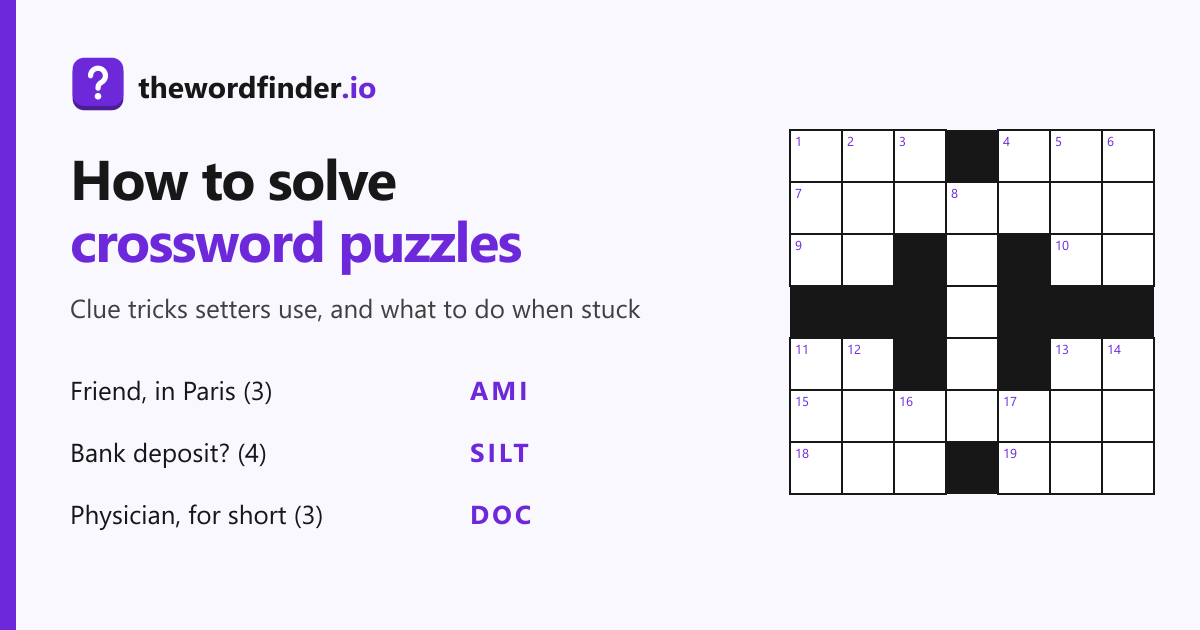
Abbreviations signal abbreviations. If the clue says “Org.” or “for short”, the answer is shortened too. “Physician, for short” is DOC, not DOCTOR.
A foreign word in the clue means a foreign answer. “Friend, in Paris” is AMI. “Yes, in Spain” is SI.
A question mark means wordplay. “Bank deposit?” might be SILT rather than anything to do with money. When you see the question mark, stop reading the clue literally.
The first word is always capitalized, so a clue like “Turkey’s neighbor” might be about a country or about a bird. Setters use that to hide proper nouns.
Know how hard the puzzle is meant to be
Daily crosswords aren’t equally difficult. The New York Times puzzle gets harder from Monday to Saturday, and the bigger Sunday grid sits around midweek level. If you’re learning, start early in the week and work up. Quick crosswords in British papers use plain definitions throughout, which makes them good practice; cryptics are a different game, where every clue hides a definition plus wordplay.
When you’re stuck
Leave it and come back. A fresh look after a few minutes catches readings you missed, and in the meantime you can fill crossings elsewhere.
Say the clue out loud, with the stress in different places. Many wordplay clues only click when you hear the second meaning.
Write in the letters you’re confident about, even if you don’t know the whole word. A pattern like _ R _ N _ shrinks the field fast, and a crossword solver can list every word that fits it.
What to look for in a crossword solver
A solver is useful when it helps you finish the puzzle without handing you answers you didn’t ask for. The ones worth using do a few things well:
- They take the clue and the letters together. A plain definition clue plus two crossings usually narrows things to one answer.
- They handle every length, from three-letter fill to fifteen-letter themers, and let you leave gaps anywhere.
- They explain the answer. Seeing what a word means lets you check it against the clue instead of trusting a list.
- They’re free and fast, with no sign-up between you and the next square.
Ours does those things: type the clue if you want, the answer length and the letters you have, and you get the likely answers first with every other fitting word below. For one-word clues there are also crossword clue pages that group answers by letter count and say why each one fits.
Practice beats tricks
None of this replaces doing puzzles. Every grid you finish teaches you a few more setter habits and a few more short answers, and after a few weeks the early-week puzzles start to feel easy. If you want something to warm up on, our word games are free and never run out.